A few years ago, I was sitting with a group of people who are now in very different professional leadership roles, and somehow the conversation moved away from our current jobs and into our earlier years. We started talking about the experiences that shaped us before any of us had a job title, a professional identity, or a clear idea of where life was heading.
What caught my attention was how often the same kind of story appeared. One of the people around the table had been the President of the Student Parliament across UNRWA schools. Another had served as Vice President. I had been a Vice President of the Student Parliament at Al Hussein College when I was sixteen. Someone else had represented his school in a regional reading competition. The experiences were different, but there was a shared thread: many of us had been given an early opportunity to participate, represent others, and take responsibility while we were still at school.
That conversation stayed with me because I had already begun noticing something similar in my work with young people. At Liwan, and through the youth groups and initiatives I have worked with in other spaces, I would often hear young people describe a later experience, a youth initiative, a volunteer project, a leadership role, a training programme, and then, somewhere in the middle of the story, they would go back to school. "I was on the student council." "I was part of the student parliament." "I represented my school." It came up often enough that I started to wonder whether we underestimate what those early experiences actually do to a young person's development.
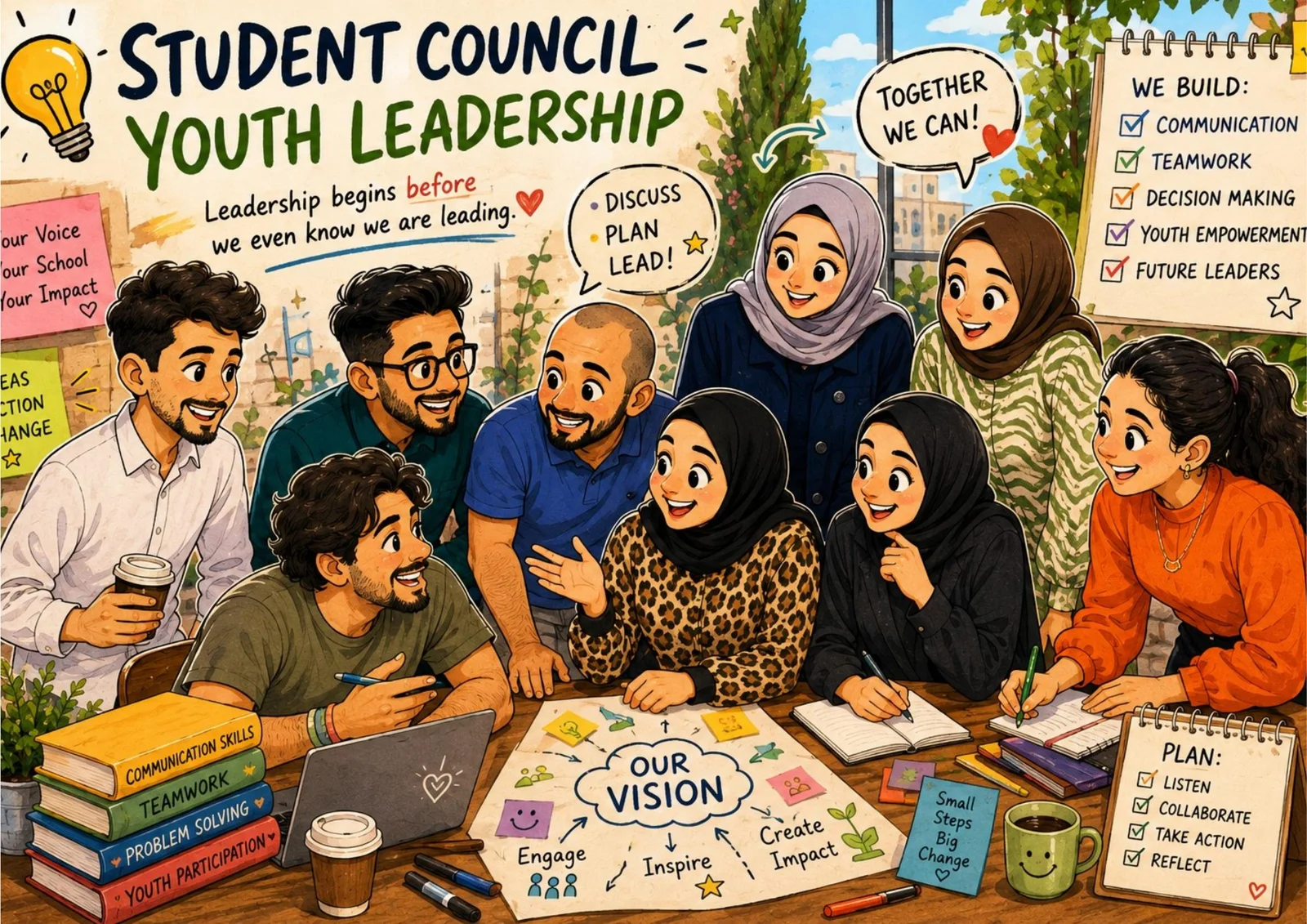
The more I thought about it, the more I became convinced of one thing: a student council does not create a leader. But it can give a young person something equally important, an early place to practise leadership before they even know that is what they are doing.
Leadership Starts Long Before the Job Title
We often talk about leadership as if it begins later in life. We picture a manager leading a team, a founder building a company, a director making decisions, or a community leader speaking on behalf of others. Those are visible forms of leadership, so it is easy to forget that the habits behind them can start much earlier.
Sometimes leadership begins when a student stands in front of classmates and says, "I think we should do this." It begins when that student has to explain the idea, answer questions, convince people who are not immediately convinced, and perhaps approach the school administration for support. It develops when a group disagrees and someone has to find a way forward without turning the disagreement into a personal conflict.
None of those moments looks particularly dramatic. Yet they are very real leadership experiences. The young person is learning to communicate, negotiate, listen, influence, make decisions, and take responsibility for the consequences. Most importantly, they begin to understand that having a good idea is only the beginning. The real challenge is getting people to work with you.
That is why I hesitate to call student councils a "factory for future leaders." They are not. A position does not automatically produce leadership. What matters is what the young person actually gets to do with that position. A meaningful experience can be an early training ground for leadership; a symbolic position with no responsibility may teach very little.
A student council does not create a leader. But it can give a young person something equally important: an early place to practise leadership before they even know that is what they are doing.
What Does a Student Actually Learn When They Join a Student Council?
At sixteen or seventeen, most students are not thinking about leadership competencies. They are thinking about school, friends, activities, elections, and whatever else is happening in their lives. They are unlikely to say, "This experience is going to improve my negotiation skills." Yet that is often exactly what is happening.
A student council puts young people in situations where they have to move beyond their own point of view. It teaches them that representing others is not the same as speaking for yourself. It teaches them that an idea needs a convincing explanation, that people can disagree without being enemies, and that compromise does not always mean giving up. Sometimes it means finding a solution that allows the group to keep moving.
It also gives young people practical exposure to communication, teamwork, persuasion, conflict resolution, decision-making, relationship building, time management, and problem-solving. These are the same skills we later discuss in universities, workplaces, and leadership development programmes. The difference is that a teenager can learn them through a real situation rather than through a slide deck.
That distinction matters. There is a big difference between hearing that negotiation is important and discovering, at sixteen, that you cannot get your idea approved unless you learn how to negotiate.
I Know This Because I Was Sixteen When I Lived It
This is not just an observation I have made as a trainer. It is part of my own story.
When I was sixteen, I was a Vice President of the Student Council at Al Hussein College. I did not have the language I use today when I talk about youth leadership, participation, facilitation, or leadership development. I was simply a teenager who had ideas and wanted to see some of them happen.
One of the projects we started was called "The Future School." We did not finish it. Looking back, there are plenty of things we could have planned better, communicated better, or approached differently. At the time, though, I was much more focused on getting the idea off the ground than on analysing what I was learning.
Years later, I can see that the process taught me more than the outcome ever could. I learned how to take an idea to school administration, how to explain why it mattered, how to listen when someone challenged it, and how to negotiate rather than simply insist. I also learned that a project is rarely moved forward by one person alone.
That led me outside my own school. I started building relationships with nearby schools in the Jabal Al Hussein area and connecting with students I would not otherwise have known. At sixteen, I would not have described this as networking, cross-cultural learning, or intellectual flexibility. I simply knew that working with different people was opening my mind.
Looking back, I can see why that mattered. When you spend time with people who come from different environments and think differently from you, you discover that there is rarely only one way to understand a problem. You learn to question your own assumptions. You become more flexible. You build relationships across circles that would otherwise remain separate.
Those are leadership skills too, even when they do not look like leadership from the outside.
The Real Shift: From "I Have an Idea" to "How Do We Move Together?"
For me, this is where student leadership becomes especially valuable. There are plenty of young people with ideas. The harder skill is turning an idea into something that other people are willing to work on with you.
A student might say, "I want us to organise this activity." That sounds simple until the practical questions begin. Who is going to help? Who needs to be convinced? How will the work be divided? What happens when two people want different things? What if the administration says no? What if someone loses motivation halfway through? What if the first plan does not work?
These are not abstract leadership questions. They are the everyday mechanics of working with people.
And this is one of the most valuable things a student council can offer. It can gradually move a young person from thinking in terms of "What do I want?" to asking, "How do we move forward together?" That is a major shift. It is the difference between having an opinion and being able to build collective action around an idea.
Anyone who later leads a project, manages a team, builds a youth initiative, works in civil society, or simply wants to make change in their community will eventually face that same challenge.
I Have Seen the Pattern Again in Youth Spaces
My experience at Liwan reinforced the observation I had first made years earlier.
In the Nahw 18 project implemented at Liwan, many participants had already been involved in the student council connected to the Greater Amman Municipality or in student unions and school-based activities. That background did not make them automatically stronger than everyone else, but in group settings some of them seemed to have a certain familiarity with the dynamics of collective work.
They were often comfortable putting an idea on the table, inviting others into the discussion, connecting different suggestions, and helping the group move toward a shared outcome. Again, I would never reduce those skills to a single experience. Young people develop through many influences, and youth spaces and community initiatives play their own part. But the school experience was clearly one piece of the story.
I noticed something similar with Model United Nations, or MUN. Young people involved in MUN are asked to research, form positions, speak publicly, listen carefully, negotiate, defend an argument, understand another perspective, and sometimes find a compromise. Those experiences can build confidence in communication and decision-making because the young person is not simply being told to "be confident." They are being placed in situations where they have to practise.
That is the part I keep coming back to: practice.
A Student Council Is One Part of a Much Bigger Ecosystem
At the same time, I would be careful about giving student councils too much credit. Young people are not shaped by one activity.
Leadership develops inside an ecosystem.
The family may be the first place where a young person learns responsibility, independence, and whether it is safe to express an opinion. School adds structure, participation, teamwork, and opportunities to represent others. Teachers can make a huge difference by giving students real responsibility rather than simply telling them what to do.
Peers matter too. Young people learn a great deal from trying to influence one another, working through disagreement, forming friendships, building alliances, and figuring out where they fit. Then come youth initiatives, community projects, youth spaces, volunteering, university experiences, civil society organisations, and eventually the workplace. Each environment adds another layer of experience.
That is why I think about youth leadership as an ecosystem rather than a programme. The student council can be one of the first spaces in that ecosystem where leadership becomes visible and practical, but what happens before and after the experience is just as important.
A young person who has a meaningful school experience and then finds another space to lead at university, another opportunity to volunteer, and later another challenge at work is building a leadership muscle over time.
The development is cumulative.
Not Every Student Leader Will Become a Great Leader
I also think it is important to say this clearly, because youth work becomes less useful when we romanticise certain experiences.
Not every student council president will become an influential leader. And not everyone who never joined a student council will struggle with leadership. People grow through different pathways. One young person may find leadership through sport. Another may discover it through volunteering, entrepreneurship, art, family responsibilities, community work, or simply having to organise something that mattered to them.
So I see student council participation as an opportunity, not a guarantee.
What matters is the quality of the experience. Did the young person have real responsibility? Did they have a voice in decisions? Were they allowed to propose something? Did they have to persuade someone? Could they disagree respectfully? Could they make mistakes without being humiliated? Did they have to deal with the consequences of a decision?
Those questions are much more important than whether the student had "President" or "Vice President" written on a certificate.
A title can look good on a CV. A real experience changes how you behave.
Failure May Be One of the Best Things They Learn
One of the most useful things I took from my own experience is that the projects that do not fully work can still be extremely valuable.
"The Future School" never became the finished project we had imagined. Yet I still remember it because it taught me what happens when an idea meets reality. It taught me that implementation is harder than presentation. It taught me that support has to be built. It taught me that relationships matter. It taught me that sometimes the idea is fine but the timing, the approach, or the context is wrong.
Those lessons are difficult to learn from theory.
Young people need opportunities to fail in ways that are safe enough to learn from. They need adults who do not turn every mistake into a verdict about their ability. They need spaces where a failed initiative can become a reflection exercise rather than a reason to stop trying.
That is part of leadership development too.
Why Do These Early Experiences Stay With Us?
Maybe because we remember what we lived more deeply than what we were told.
A young person who has stood in front of a group, defended an idea, faced questions, negotiated with an adult, dealt with disagreement, and tried to keep a team moving has a reference point to draw on later.
When that person walks into university, joins a youth initiative, enters a new workplace, or finds themselves in a difficult meeting years later, they may not know exactly how to handle the situation. But they are not meeting uncertainty for the first time. Somewhere in their memory is the feeling of having tried something difficult before.
That is one way I now think about confidence. Confidence is not always something we simply "have." Sometimes it is evidence accumulated over time: I have spoken before. I have negotiated before. I have handled disagreement before. I have made a decision before. I have failed before and recovered.
The experience becomes part of the person.
Perhaps We Are Asking the Wrong Question
The longer I work with young people and leaders, the less interested I am in asking whether a particular young person is "a leader."
I am much more interested in asking whether we have given that young person enough opportunities to practise leadership.
Have we allowed them to make a real decision? Have we given them a problem that does not have an obvious answer? Have we let them disagree with us respectfully? Have we allowed them to lead a group rather than simply participate in one? Have we given them room to test an idea that might not work? And after something goes wrong, have we helped them make sense of what happened?
If we are serious about youth leadership development, youth empowerment, and meaningful youth participation, we cannot depend only on leadership workshops. Young people need real situations in which leadership matters.
They need schools where student councils have a purpose beyond elections. They need organisations that take youth participation seriously. They need youth spaces where experimentation is welcome. They need initiatives where young people are trusted with real responsibility. And they need adults who are willing to share some control rather than only asking young people to "take the lead" in theory.
Leadership May Begin in a Much Smaller Place Than We Think
When I look back at the young people I have worked with and the leaders I have met, very few leadership stories begin with something impressive on paper.
They usually start small. A student decides to run for student council. Someone volunteers to represent their classmates. A group of friends decides to organise something. A teenager tries to convince school administration that an idea is worth supporting. Someone joins MUN and discovers that they are capable of speaking up even when they are nervous.
At the time, nobody knows exactly what these experiences will lead to. The young person certainly does not have a five-year leadership development plan. They are simply doing something that matters to them.
But those experiences can become building blocks.
One experience leads to another. A school activity makes a youth initiative feel less intimidating. A youth initiative makes a university project feel possible. A university project creates confidence for a workplace challenge. Relationships built in one setting open doors to another. Over time, what once looked like separate activities starts to resemble a path.
That is why I keep coming back to student councils when I think about youth leadership. Not because they are the answer, and certainly not because every student council member will become a leader. I value them because they can be one of the first places where a young person discovers something important: that their voice can influence a group, that an idea can move beyond their own mind, and that responsibility is something they can carry.
Maybe leadership begins with a speech in front of classmates. Maybe it begins with a difficult conversation with a school principal. Maybe it begins with a small project that never gets finished.
What matters is that someone was given the chance to try.
And sometimes, years later, that sixteen-year-old who simply wanted to make something happen looks back and realises that the first chapter of their leadership journey was already being written.
Leadership does not always begin with a job title. Sometimes it begins years earlier, when a young person is given a real reason to stand up, bring people together, and say: I have an idea. Let's try.
Related reading: see also why most leadership programs fail, or explore the difference between youth participation and youth agency.
Frequently Asked Questions
Found this useful? Share it with your network.
 Share on LinkedIn