A few years ago, while working on a youth program, we thought we knew what young people needed. We had done the planning, identified the skills, designed the activities, and, like many development programs, were moving forward with a clear idea of what should be delivered.
Then, during a conversation, one young person challenged one of our assumptions: "This skill is not really what we need."
It could easily have been treated as a simple comment, but instead, we listened. We went back, asked more questions, and looked again at what young people were actually interested in. What we discovered was important: some of our assumptions did not fully reflect their priorities. Their interests were shifting toward other technical areas, including organic agriculture and skills connected to emerging opportunities.
So, we changed parts of the program.
It was a relatively small moment, but it changed something much bigger in the way I think about youth programming.
Sometimes, one young person in the room can see a future that an entire project design has missed.
Participation Is Not the Same as Agency
Over the years, one concept has increasingly shaped how I think about working with young people: youth agency.
We often use words such as participation, engagement, empowerment, and youth-led. But having young people in the room does not automatically mean they have agency.
Real agency requires preparation and access to knowledge and skills. It requires spaces where young people can express themselves safely and confidently. Most importantly, it requires trust and the ability to influence what happens next.
There is a significant difference between asking young people, "What do you think about the program we designed?" and asking, "What problem should we be solving together?" The first invites feedback; the second shares ownership.
This distinction matters because youth participation can easily become symbolic. We can organize consultations, focus groups, youth committees, workshops, and dialogue sessions. We can collect hundreds of recommendations. But at the end of all these activities, we should still ask ourselves one important question:
Did young people actually influence the decision?
If the answer is no, then participation may have happened, but agency probably did not.
Are Young People the Purpose or the Instrument?
This is one of the uncomfortable questions institutions working with young people need to ask.
Programs are often described as youth-centered, youth-led, or youth-focused. Yet institutional realities can sometimes push us in another direction. We have indicators to achieve, activities to deliver, budgets to manage, timelines to follow, reports to submit, and targets to reach.
Without realizing it, young people can become a means of achieving those requirements rather than the reason the program exists in the first place.
That is where we need to return to a simple question:
Was this program designed around what young people actually aspire to, or around what the institution was already prepared to deliver?
The difference is fundamental.
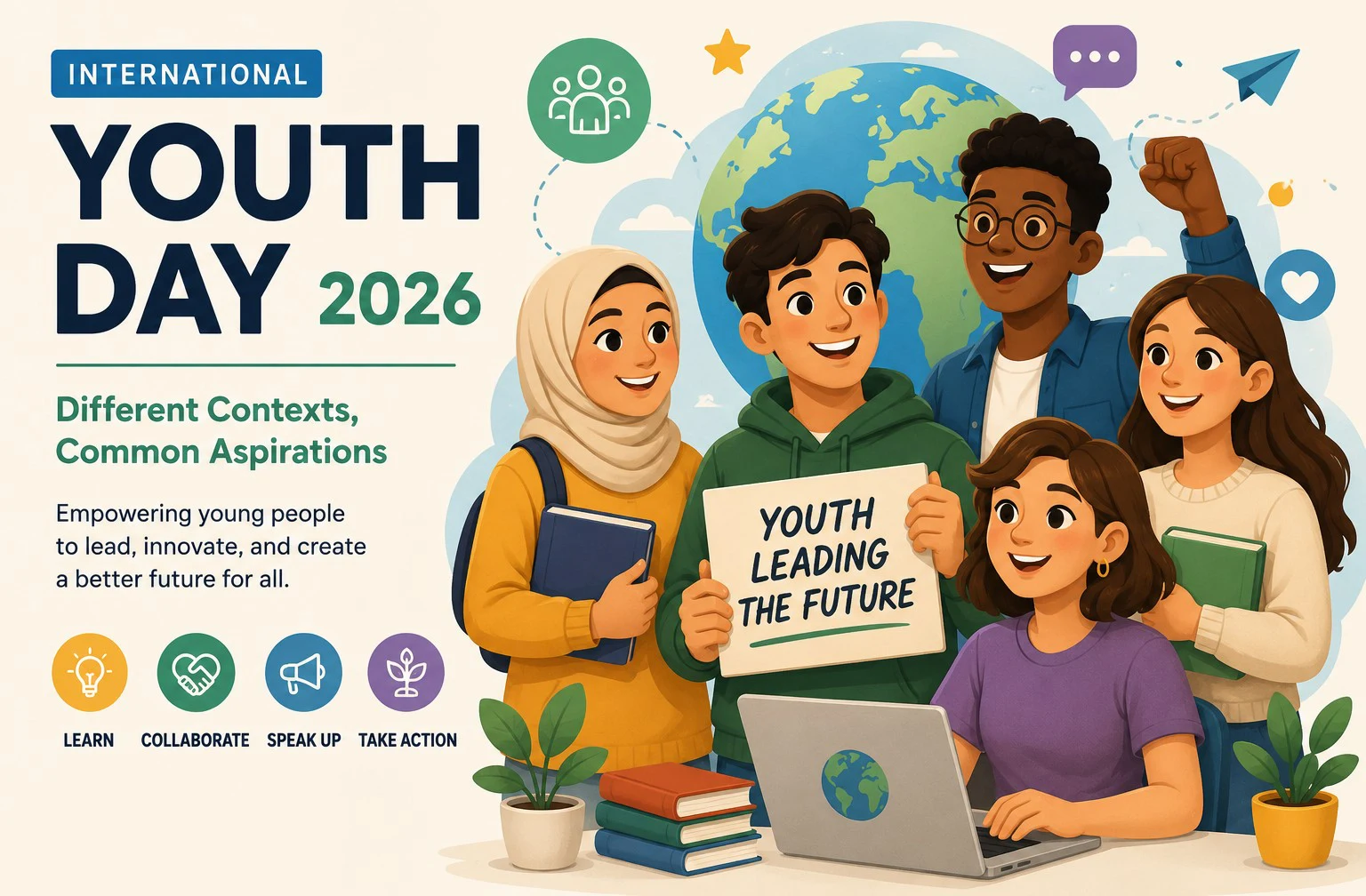
International Youth Day 2026 is being observed under the theme "Different Contexts, Common Aspirations." Young people live in very different realities. Geography, economic conditions, access to education, technology, conflict, inequality, and opportunity all shape their experiences differently.
Yet many aspirations cross those boundaries. Young people want opportunities, meaningful work, access to learning, and the ability to contribute to their communities. They want their ideas to matter, and increasingly, they want to participate in shaping the decisions that determine their future.
The contexts may be different, but many of the aspirations are shared.
Maybe the Problem Is Not a Lack of Potential
We often talk about "unlocking youth potential." But after years of working with young people, I increasingly question whether potential is really the problem.
Perhaps what is missing is space and trust.
When I talk about space, I do not only mean a physical youth center or a room where young people can meet. Space can also mean having a real place in decision-making, where their opinions can influence policies, programs, and investments.
It means having experimental spaces where young people can try something new, make mistakes, learn, and try again without every step being predetermined. It also means having access to digital spaces where they can use technology, networks, knowledge, and emerging tools, as well as leadership spaces where they are not always expected to wait until they are older or more experienced before being allowed to contribute.
Creating those spaces, however, requires something difficult from institutions: trust.
Trust becomes meaningful when institutions are willing to give up some control. We cannot tell young people, "We trust your voice," while every important decision has already been made. We cannot encourage innovation while expecting every new idea to fit perfectly within an existing project plan. And we cannot talk about youth leadership while young people remain at the bottom of the decision-making structure.
Youth agency requires institutions to give up a small part of their control.
That may be uncomfortable, but it is necessary.
AI Has Changed the Equation
This conversation becomes even more important in 2026 because artificial intelligence is changing how people learn, work, communicate, create, and solve problems.
For young people, this represents an extraordinary shift. A young person today can use AI to learn a new skill, analyze information, develop an idea, build a prototype, create content, research a market, start a business, or connect with opportunities far beyond their immediate community.
Knowledge that once required access to institutions, experts, expensive courses, or professional networks is becoming increasingly accessible.
This does not mean that access is equal, nor does it mean that AI automatically creates opportunity. Digital inequality, misinformation, skills gaps, and unequal access remain serious challenges. But something fundamental has changed:
The distance between having an idea and being able to do something with it is becoming shorter.
This generation has access to tools that previous generations could hardly imagine. And that creates an interesting contradiction: young people have more tools to shape the future than perhaps any generation before them, yet many still have limited influence over the decisions shaping their own lives.
That is why youth empowerment in the age of AI cannot simply mean teaching young people how to use new technology. We need to develop critical thinking, adaptability, digital and AI literacy, communication, leadership, green skills, entrepreneurship, and the ability to question, evaluate, create, and make responsible decisions.
The objective should not only be preparing young people to compete for the jobs that exist today. It should also be preparing them to help create the opportunities, industries, solutions, and institutions that will exist tomorrow.
From "For Youth" to "With Youth"
Moving from participation to agency requires more than changing the language we use. It requires changing how programs and institutions operate.
1. Design With Young People, Not Only for Them. Youth participation should begin before the project proposal is finalized, before activities are selected, and before training topics are decided. Ideally, it should begin even before the problem itself has been completely defined. Young people should participate in identifying challenges, designing solutions, implementing activities, evaluating results, and deciding what should happen next.
That small experience of changing a program after listening to one young person's feedback taught me something I continue to carry with me: when young people participate throughout the project lifecycle, they do more than improve the program.
They can reveal changes that institutions have not noticed yet.
2. Transfer Real Decision-Making Power. Not every organizational decision can or should be transferred to young participants, but some decisions must be. There should be areas where young people know that what they say can actually change what happens. That is where participation begins to become agency.
If young people can speak but cannot influence, we have created a platform. If they can speak, influence, participate in decisions, and take responsibility for the outcome, we have started creating agency.
3. Prepare Young People for Agency, Not Just Participation. Giving someone a seat at the table is important, but preparing them to use that seat effectively is equally important. Agency requires capacity. Young people need knowledge, confidence, networks, exposure, mentorship, and opportunities to practice decision-making.
We should therefore stop thinking about empowerment as a single training, workshop, or activity. Instead, we should see it as a process that moves from preparation and capacity building to creating space, building trust, enabling influence, and eventually sharing decision-making power. That is how participation can gradually become agency.
A Shared Responsibility
There is also responsibility on the other side of the table. Agency is not only something institutions enable; it is something young people need to build the capacity to exercise.
Young people need to continue learning, questioning, experimenting, and staying curious. They need to understand the technologies changing the world around them, strengthen their ability to communicate their ideas, challenge assumptions, and develop the confidence to contribute meaningfully when they enter decision-making spaces.
A young person's voice becomes more powerful when it is supported by knowledge, preparation, and the capacity to turn ideas into action.
At the same time, institutions need to stop inviting young people only to validate decisions that have already been made. They need to bring them in early enough to change those decisions.
This means listening when young people's priorities challenge institutional assumptions, creating spaces where disagreement is possible, giving young people responsibility rather than only visibility, and investing in their capacity while trusting them enough to use it.
Because the young person questioning a program today may be noticing an economic, technological, social, or cultural shift that an institution will only recognize tomorrow.
That is not a threat to institutional expertise. It is exactly why intergenerational collaboration matters.
Beyond International Youth Day
International Youth Day gives us an opportunity every year to celebrate young people. But celebration alone is not enough.
Young people need institutions willing to listen. They need spaces where they can experiment and participate meaningfully. They need opportunities to influence decisions, the capacity to take responsibility, and the trust required to exercise real agency.
The challenge, therefore, is not simply to ask how we can prepare young people for the future. We should also ask how much space we are willing to give them to shape it.
Young people should not simply be prepared for the future. They should be trusted to help shape it.
This year's theme reminds us that young people may come from different contexts while sharing common aspirations. Our responsibility is to make sure those aspirations are not only heard but reflected in the programs, institutions, policies, and decisions that will shape the years ahead.
Perhaps our next step is to move beyond promising young people empowerment and start creating the capacity, space, trust, influence, and decision-making power that allow them to exercise real agency.
Related reading: see also Human Capital in the Gulf's New Era, or explore our leadership development and youth-centered program design services.
Found this useful? Share it with your network.
 Share on LinkedIn