I recently watched the Mourinho documentary on Netflix, and I came away thinking more about the man himself than the trophies he has won. I already knew the famous story: "The Special One," the press conferences, the rivalries, the titles, and the controversies that have followed him throughout his career. But the documentary made me take a step back and ask a different question: how did Mourinho become Mourinho? How did someone who was never a major football star as a player, and who did not begin his career as a high-profile manager, walk into clubs with completely different cultures, expectations and challenges, and still leave such a strong mark on each of them?
That is when I started looking at his story through the lens of leadership. The documentary goes beyond Mourinho's public image and brings together people who experienced different parts of his career, including Frank Lampard, John Terry, Iker Casillas, Zlatan Ibrahimović, Javier Zanetti, Luis Figo, Samuel Eto'o and others. That made me feel that the most interesting way to read the documentary is not simply as the story of a football manager, but as a study in leadership, people management and team management under extreme pressure.
The Beginning People Often Overlook
Mourinho was never a major football player. He played in Portugal, but he did not build the kind of career that would take him to stardom. He stopped playing relatively early and began looking for another way to remain inside the game. In 1992, he got the opportunity to work with Bobby Robson at Sporting Lisbon as an interpreter. On paper, it was a simple role. In reality, it put him close to the centre of decision-making: around training sessions, meetings, analysis, and conversations with players, management and the media.
He watched, and he learned. Over time, his role went well beyond translation. He became increasingly involved in technical and analytical work, then followed Robson to Porto and later to Barcelona, where he worked with Louis van Gaal. Those years became a practical education in leadership. From Robson, Mourinho learned a great deal about relationships with players, communication and the human side of leadership. From Van Gaal, he learned the value of structure, discipline, preparation and attention to detail.
Before Mourinho became a leader, he was learning from leaders. Before he became the person making the decisions, he was watching how decisions were made. That background matters when we look at his later career, because his leadership was never built around tactics alone. It was also built around reading people, understanding pressure, creating identity and shaping the story around a team.
From Benfica to Porto: When Responsibility Became Real
In 2000, Mourinho got his first opportunity as a head coach at Benfica. He later moved to União de Leiria before returning to Porto in 2002. That was when the transformation the world knows began. He won the Portuguese league, the Portuguese Cup and the UEFA Cup in his first full season, then won the Champions League in 2004.
But what interests me about Porto is not the trophy alone. Mourinho managed to make a team without the resources of Europe's biggest clubs believe it could compete with them. That was one of his greatest leadership skills: building belief before the results arrived. A leader does not simply give a team an objective. A leader helps the team believe that the objective is actually possible.
Chelsea: When the Manager Became Part of the Team's Identity
When Mourinho arrived at Chelsea in 2004, the club already had money, talent and ambition. But Chelsea had been waiting for a league title for 50 years. Mourinho arrived and changed that. Chelsea won the Premier League in his first full season with 95 points and retained the title the following season.
But his influence went far beyond tactics. Frank Lampard's testimony in the documentary is particularly interesting here. It shows a Mourinho who saw himself as responsible for more than the tactical side of the game. He dealt with the media, defended his players, looked for ways to motivate them, and was willing to put himself at the centre of the pressure when things became difficult.
That matters in leadership. A leader does not have to solve every problem for the team, but people need to feel that they will not face difficult moments alone. Mourinho understood that very well. He knew that the dressing room needed to feel that someone was standing in front of them when pressure came from outside. At the same time, he understood that protection could not come without accountability. He could build a close relationship with his players and still demand a great deal from them. That balance between trust and accountability is one of the hardest things for any leader to get right.
Mourinho and the Art of Managing Different Personalities
One of Mourinho's strongest qualities has always been his ability to deal with different personalities. He did not treat every player the same way. A dressing-room leader needed something different from a young player trying to establish himself. A highly confident star needed a different approach from someone struggling with confidence.
This is where his people-management skills become particularly interesting. Mourinho did not manage only the formal structure of the dressing room. He paid attention to the informal relationships as well. Who had influence? Who needed support? Who needed a challenge? Who could become a leader for others?
From a project-management perspective, you could almost look at the dressing room as the core delivery team, with the players responsible for turning the strategy into results. That is why stakeholder engagement inside the team became such an important part of Mourinho's daily work, even if he never used those exact terms.
Inter: When He Lost His Best Player
One of the clearest examples of Mourinho as a manager is what happened with Zlatan Ibrahimović at Inter. In the summer of 2009, Ibrahimović moved to Barcelona in a deal that brought Samuel Eto'o to Inter along with a significant financial payment. Ibrahimović had been Inter's top scorer in Serie A the previous season, with 25 goals. His departure was therefore not a minor change. Mourinho had lost one of his most important sources of goals and one of the players who could change a game through individual brilliance. At the same time, he still had a European campaign ahead of him and a team expected to compete at the highest level.
The deal itself was not Mourinho's decision alone, and that distinction matters. What is interesting is how he responded. He was dealing with a new reality: a major player had left, the balance of the squad had changed, and the team needed a new plan. Mourinho did not spend the season trying to recreate Ibrahimović. He understood that Samuel Eto'o was a different kind of player.
Eto'o brought movement, pressing and work without the ball. So the answer was not simply to replace one player with another. It was to redesign the system around the strengths of the new group. That is a very practical example of change management. When a key part of a project changes, you cannot always protect the old model. Sometimes you have to reassess the situation, look at the resources available, understand the risks, and redesign the way the team works.
Mourinho was essentially asking a bigger question: what kind of team do we need now? Not: how do we find another Ibrahimović?
Alongside Eto'o, Inter brought in players such as Wesley Sneijder, Diego Milito, Thiago Motta and Lucio. The group began to change, the football began to change, and within one season Inter had won Serie A, the Coppa Italia and the Champions League, becoming the first Italian team to win the treble.
The important management lesson is not that losing Ibrahimović was necessarily a good or bad decision. It is that Mourinho did not allow the departure of a key player to become the identity of the entire season. He accepted the new reality and moved forward. Sometimes the strongest management decision is not trying to protect everything you had before, but making the best possible use of what you have now.
Mourinho did not ask how to replace Ibrahimović. He asked what kind of team he needed now.
Eto'o, Figo and Zanetti: Managing People at Different Stages of Their Careers
Inter gave Mourinho a particularly complex group of personalities. Javier Zanetti was an experienced captain and one of the most respected figures in the dressing room. Luis Figo was already at an advanced stage of his career. Samuel Eto'o arrived after a hugely successful spell at Barcelona. Wesley Sneijder was looking for a fresh start. Diego Milito came in as an important part of the new project.
This kind of group requires more than a tactical plan. It requires team development. Mourinho knew how to give different personalities a place in the collective story. An experienced player can become an anchor for the group. A major star can become a source of energy. A new player needs enough space to feel that he is contributing to the project rather than simply filling the place of someone who has left. That is a major part of people management.
You do not always need to eliminate strong personalities from a team. Sometimes you need to understand them and channel them toward the same objective. Javier Zanetti later spoke about the depth of the relationship that developed within the Inter group and about the feeling that the players had become a family. That helps explain why the team remained so united when the biggest moments arrived. They were not simply players working together. They had a shared identity.
What makes the Ibrahimović story even more interesting is that the professional decision did not completely destroy the human relationship. Mourinho understood that Ibrahimović wanted to play for Barcelona and spoke about that desire with a level of understanding, even though losing such an important player was obviously difficult for him.
That is an important management skill. You may have to change someone's role, move someone, end a contract, or make a decision they strongly disagree with. But the way you handle the decision matters. Professional disagreement does not automatically have to become personal conflict. That ability to separate the decision from the relationship is something many managers struggle with, particularly when the person involved is talented, influential or personally close to them.
Inter: Turning a Group Into a Team
If Chelsea showed Mourinho's ability to build belief and a winning mentality, Inter showed his ability to create belonging. The players felt they were part of something bigger. They were not simply trying to win another match. They were trying to make history together.
This is where team development becomes so important. A team does not become a real team simply because talented people are put in the same room. It needs trust, communication, clear roles, a shared purpose, and the ability to work through conflict. Mourinho worked on those things constantly inside the dressing room.
In many ways, his work resembles the stages teams often go through: forming, dealing with tension and differences, establishing new ways of working, and eventually reaching a high level of performance. He may never have described it in those terms, but he was doing the work.
Real Madrid: When Managing Stars Became Much More Complicated
Then came Real Madrid, and the challenge changed completely. Mourinho walked into a dressing room that included Cristiano Ronaldo, Iker Casillas, Sergio Ramos, Xabi Alonso, Karim Benzema, Mesut Özil and many other players with huge reputations and strong personalities.
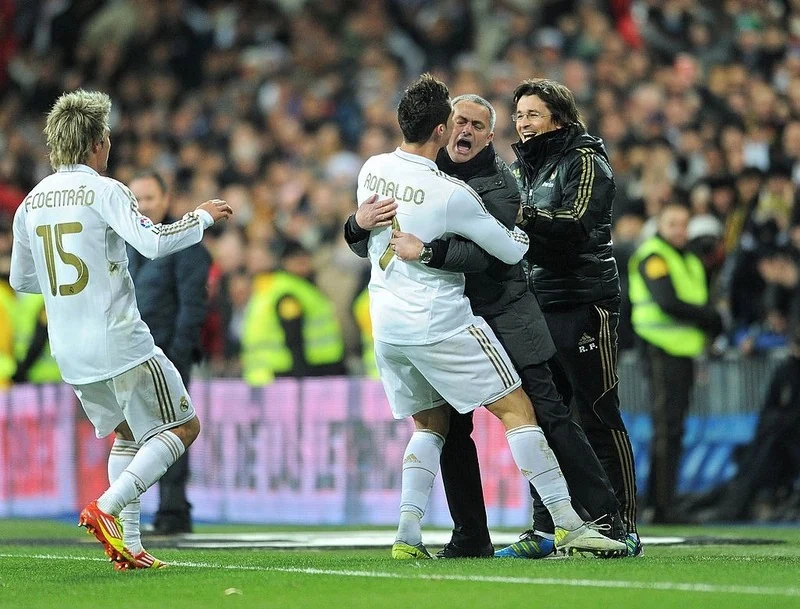
Mourinho with Cristiano Ronaldo and Fábio Coentrão during his three seasons at Real Madrid.
He led Real Madrid to the Spanish league title in 2011/12 with 100 points, while the team scored 121 goals. But success did not eliminate the tensions. The relationship with some players, particularly Iker Casillas, became increasingly complicated. There were also tensions involving Cristiano Ronaldo and others.
This is where the limits of Mourinho's approach become particularly interesting. When your relationship with the team is one of your greatest sources of influence, losing that relationship becomes a major risk for the whole project. In stakeholder-management terms, Mourinho was very strong at building a direct relationship with the dressing room. But Madrid showed that managing conflict between different groups sometimes requires a different set of skills.
A leader needs to be close to the team. But he also needs to manage the board, ownership, supporters, the media and the wider institution. That balance becomes much harder when the organisation itself is as powerful and complex as Real Madrid.
The Special One: When Personality Became Part of the Leadership
Mourinho's personality was never separate from his management style. "The Special One" was not just a line from a press conference. It became part of his identity.
He understood the media. He knew when to speak, when to create a story, when to confront someone, and when to make himself the person taking the pressure. In many situations, that was useful. When Mourinho became the subject of the media conversation, his players sometimes had more space to focus on football. When he was the one confronting the press or an opponent, the team could feel that their manager was absorbing some of the pressure for them.
But there is a very fine line here. Confidence matters. Charisma matters. Being able to stand your ground matters. But a leader also needs to know when their personality stops serving the team and starts serving itself. That is one of the reasons Mourinho is such an interesting leadership case. He is a powerful example of what charisma can achieve, but also of the risks that come with it.
Conflict: A Strength That Needs to Be Controlled
Mourinho does not naturally run away from conflict. He confronts the media, opponents, players and, at times, the people above him. That can be useful. A leader cannot avoid every difficult conversation. Sometimes you need to say no. Sometimes you need to draw a line. Sometimes you need to defend someone on your team even if it means putting yourself in the firing line.
But conflict management does not mean fighting every battle. A good manager knows which conflict deserves energy, which problem should be contained, and which conversation belongs in private rather than in front of the media.
Mourinho's career shows that the same tool can be effective in one situation and damaging in another. That is an important leadership lesson. Being strong is not enough. You also need to know when and how to use that strength.
Mourinho as a Manager: From the Tactical Plan to the People Plan
This may be the reason I see Mourinho first as a manager and only then as a tactician. The tactical plan was obviously a major part of his work, but there was always a people plan happening alongside it.
There was an objective. There was a project scope. There were resources. There were risks. There were stakeholders. There was a timeline. There was pressure. And he had to turn all of that into a team that could perform on match day. His relationship with the players was therefore part of delivery. It was not separate from football.
Every club required something different. Porto needed belief. Chelsea needed a winning mentality. Inter needed belonging. Real Madrid needed the management of a group of superstars inside one of the most demanding environments in football.
That ability to read the context is one of Mourinho's strongest qualities. A good leader does not walk into every project with the same solution. He first tries to understand the current state, identifies the gap, and then builds an intervention that fits the environment.
And What About Mourinho in 2026?
This is where the documentary becomes even more interesting for me. We are not only looking at Mourinho's past anymore. In 2026, the same man returned to Real Madrid, more than a decade after leaving the club, on a three-year deal.
I do not know whether the decision will prove right or wrong, and I do not think it would be fair to judge it too early. What makes me excited is watching this return after seeing how his personality was built.
The Mourinho coming back to Madrid is not the same man who arrived there in 2010. He brings more than a decade of additional experience, more victories, more failures, more relationships, more conflicts and more lessons, all inside a very different football landscape.
So the leadership questions become much more interesting. Did Mourinho learn from what happened at Real Madrid the first time? Can he build a strong relationship with the players without distancing himself from the club's leadership? Can he use his personality to create confidence without allowing that personality to become part of the conflict? And how will he manage a group that includes players such as Kylian Mbappé, Vinicius Junior and Jude Bellingham?
I do not know the answers yet. And honestly, that is what makes me excited to watch. I am not following Mourinho's return simply to see whether he wins the league or another Champions League. I want to see what all those years have done to the man.
We are not simply watching a manager return to a club. We are watching a leader return to one of the most important chapters of his own story, with the opportunity to understand how he got there in the first place.
Why Mourinho Is Worth Understanding as a Leader
After watching the documentary, I think reducing Mourinho to "the arrogant manager" does not do his story justice. At the same time, turning him into "the genius who never gets it wrong" would be just as misleading.
Mourinho is complicated. He knows how to build confidence, but he also knows how to create conflict. He knows how to protect his players, but he can also be extremely demanding. He knows how to make a team feel important, but there have been moments when his own personality became a huge part of the story.
And that is exactly why his career is worth studying from a leadership perspective. The best lessons do not always come from perfect people. Sometimes we learn more from people whose strengths and weaknesses are visible at the same time.
In the End
Mourinho deserves a documentary like this. Not because he is a perfect leader, not because every decision he made was right, and not because his style would work for every team. He deserves to be understood because his career is full of lessons about confidence, belonging, protection, accountability, talent management, conflict, identity and change.
What I found most interesting is that the world remembers Mourinho today as one of football's most famous managers, yet his beginning was very different. He started as a player who never built a major career, entered the coaching world through translation, learned from Bobby Robson and Louis van Gaal, became a manager, and then led Porto, Chelsea, Inter and Real Madrid. Every stage left something behind in his personality.
That may be the part of his story I appreciate most. Before Mourinho became a leader, he was learning from leaders. Before he became the person making the decisions, he was watching how decisions were made. Before he became the man facing the media, he was standing beside someone else and listening. And before he became "The Special One," he was simply someone trying to find his place in the game.
That is why I did not finish the documentary asking whether Mourinho is a good leader or a bad one. I came away with a different question: what can I learn from his experience, and where should I draw the line? How can I learn from his successes without repeating his mistakes?
Because leadership is not about becoming Mourinho, or becoming a copy of any other leader. It is about watching, learning, experimenting, understanding yourself, understanding the people you lead, and eventually building your own way of moving people toward something bigger than themselves.
Before he became "The Special One," he was someone who learned from others. Perhaps every real leader starts from the same place.
Related reading: see also why most leadership programs fail, or explore what the World Cup teaches us about leadership under pressure.
Frequently Asked Questions
Found this useful? Share it with your network.
 Share on LinkedIn