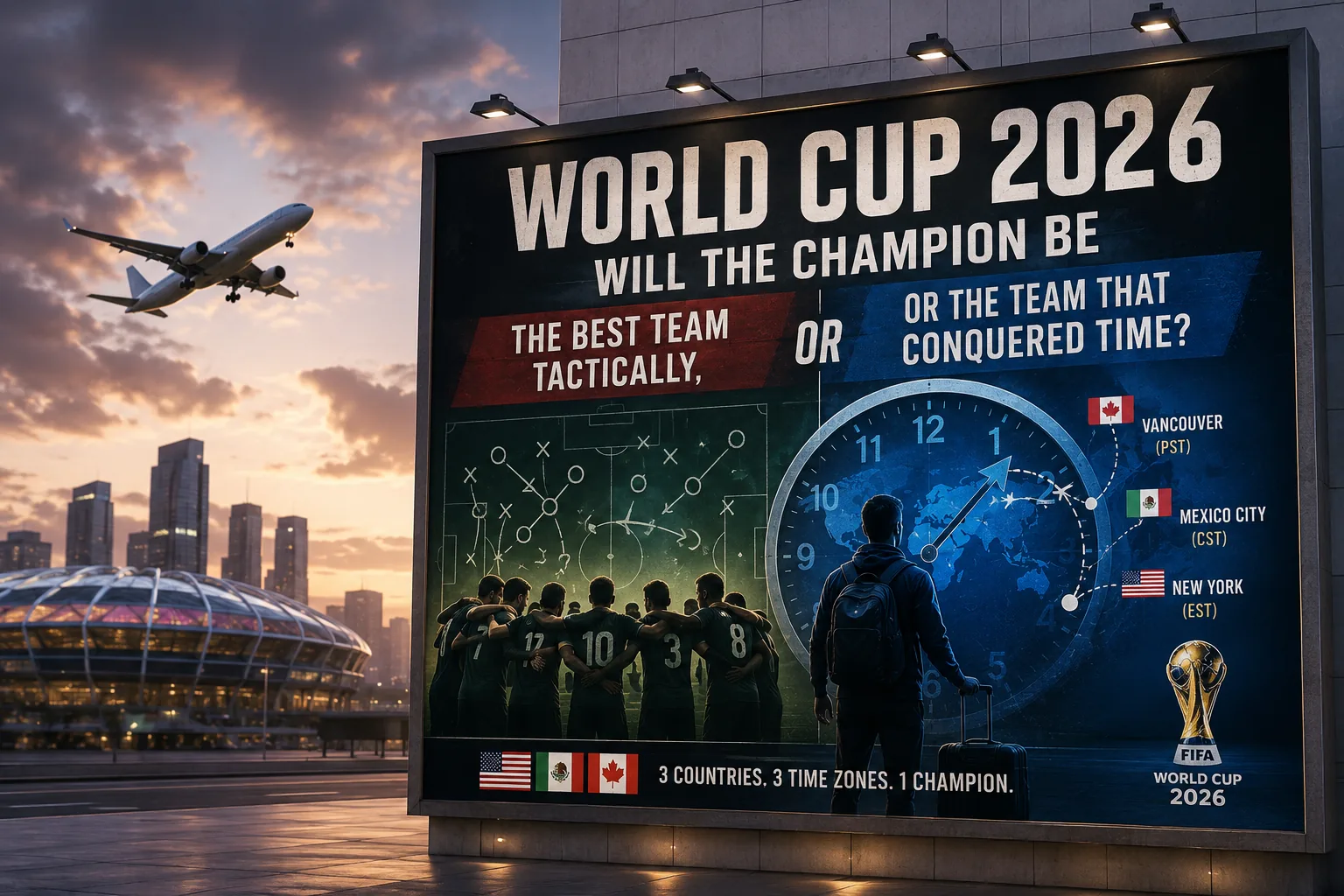
When people discuss the FIFA World Cup 2026, the conversation usually focuses on tactics, star players, and squad depth.
But there is a dimension of this tournament that rarely gets discussed. And it has everything to do with leadership.
For the first time in history, the World Cup will be hosted across three countries: the United States, Canada, and Mexico. Teams will travel enormous distances between matches, crossing time zones, adapting to different climates, and managing constant disruption.
In other words, they will be asked to perform at their highest level under conditions that are deliberately uncomfortable.
Sound familiar? This is exactly what we ask of leaders every day.
Every organization I have worked with eventually faces its own version of a three-country tournament: shifting conditions, compressed timelines, and no control over the environment they have to perform in.
The Expanded Format Is a Lesson in Scale
This tournament also introduced an expanded 48-team format, the largest in the competition's history. More teams, more matches, more logistics, and a far larger margin for something to go wrong.
Scaling a leadership program creates the exact same tension. A pilot that works beautifully with 30 participants in one city does not automatically work with 3,000 participants across six countries. The core idea has to survive contact with scale, different infrastructures, different cultural expectations, and different local capacities.
The teams that will succeed in this tournament are not necessarily the most talented on paper. They are the ones whose systems, coaching structures, and squad depth were built to absorb disruption without losing their core identity. That is precisely what distinguishes leadership development programs that hold up under expansion from ones that quietly fall apart once they leave their original pilot city.
Managing Fatigue Is a Leadership Skill, Not a Logistics Problem
Coaches preparing for this tournament have spent years thinking about recovery windows, squad rotation, and travel fatigue. They understand that a team's performance in the final weeks depends on decisions made months earlier about who gets rest and when.
I see the same pattern in organizations that treat burnout as an HR issue rather than a leadership issue. Teams delivering long, demanding programs do not fail because people are lazy. They fail because leaders wait too long to rotate responsibilities, protect recovery time, or acknowledge that sustained intensity has a cost.
The organizations that consistently perform well over long, disruptive periods are the ones whose leaders plan for fatigue in advance, the same way a national coach plans a rotation policy before a ball is ever kicked.
Culture Travels, or It Does Not Survive the Trip
Teams competing across three countries cannot rely on a single home stadium, a familiar training ground, or a predictable set of fans in the stands. Whatever identity and discipline they have built has to travel with them, independent of the environment.
This is one of the most demanding tests for any organization operating across multiple countries, which is most of the organizations I have worked with across the Gulf and MENA. A leadership culture that only functions in one office, with one team, under one set of familiar conditions, is not actually a culture. It is a habit tied to a specific room.
The real test of a leadership program, like the real test of a national team, is whether its principles still hold up when the stadium changes, the language changes, and the pressure changes with it.
Pressure Reveals Design, Not Character
There is a common belief that pressure reveals character. I think that is only half true. Pressure mostly reveals design. It shows you where your systems, your bench strength, and your decision-making structures were built to hold, and where they were only ever held together by good intentions.
A tournament played across three countries, with an expanded field of teams, under constant travel and disruption, will expose every gap in preparation that was previously hidden by convenience. The same is true for any organization operating under real pressure. The gaps were always there. Pressure just makes them visible.
The teams, and the organizations, that come out ahead will not be the ones who avoided pressure. They will be the ones who built for it long before kickoff.
Related reading: See also Human Capital in the Gulf's New Era, or explore our leadership training services.
Frequently Asked Questions
Found this useful? Share it with your network.
 Share on LinkedIn