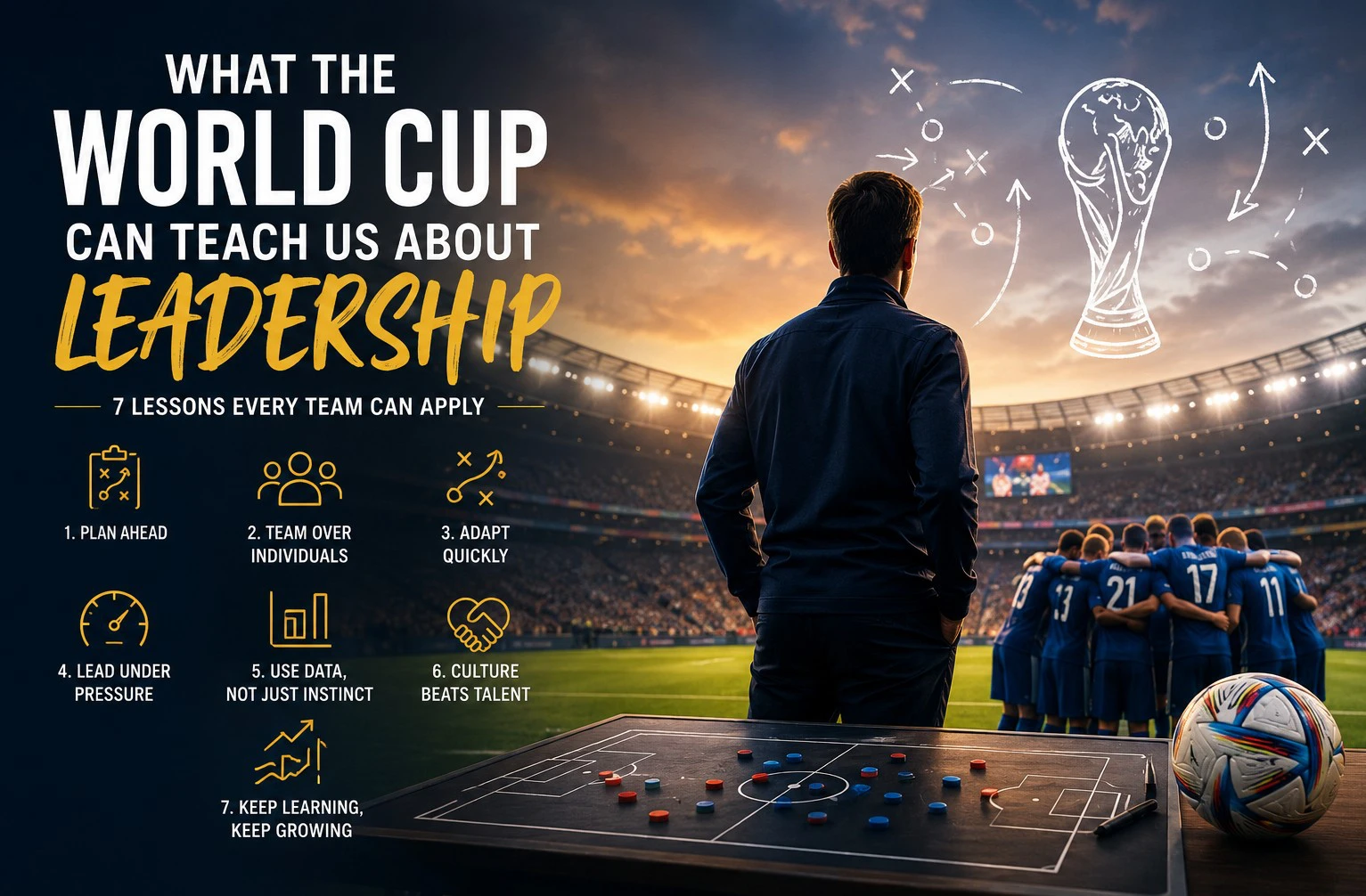
Every four years, the world comes together around an event that transcends sport. The FIFA World Cup unites nations, cultures, and generations through a shared passion. Yet beyond the excitement of goals and trophies, it offers something even more valuable: one of the world's most compelling case studies in leadership.
The FIFA World Cup 2026 has reinforced that idea more clearly than ever. As the largest tournament in the competition's history, featuring 48 national teams for the first time, it has expanded the competitive landscape and shown that the gap between football's traditional powers and emerging nations is steadily narrowing.
While millions of fans focused on match results, another story unfolded behind the scenes: a story of long-term national strategies, years of investment in talent, courageous leadership, and organizational cultures built well before the opening whistle.
Viewed through this lens, football becomes much more than a game. It becomes a living laboratory of leadership, one that offers valuable insights for executives, entrepreneurs, project managers, nonprofit leaders, and anyone responsible for guiding people toward a shared vision.
1. Championships Begin Long Before Kickoff
Great achievements are never created overnight. They are the result of years of planning, learning, investing, adapting, and continuously developing people, and the FIFA World Cup 2026 illustrates this principle perfectly.
Teams such as Argentina, France, Spain, and England reached the tournament's decisive stages not simply because of individual talent, but because they have spent years strengthening youth academies, investing in coaching, embracing sports science, analyzing performance data, and building cultures that consistently produce excellence.
Beyond the traditional football giants, the tournament also highlighted inspiring stories from emerging nations. For Jordan, qualifying for the FIFA World Cup for the very first time represented far more than a sporting milestone. It reflected years of strategic development, technical stability, growing confidence, and a national commitment to raising competitive standards.
Saudi Arabia entered the tournament with valuable World Cup experience, supported by substantial investments in domestic football, club development, youth academies, and sports infrastructure, closely aligned with the Kingdom's broader national vision, where sport has become an important pillar of economic and social transformation. Morocco demonstrated that its historic success in 2022 was not an isolated achievement, and the 2026 tournament confirmed that sustainable excellence comes from building long-term systems capable of producing competitive teams year after year.
Egypt returned to the World Cup carrying one of Africa's richest football traditions while focusing on developing a new generation capable of restoring the country's consistent presence on football's biggest stage. Across Africa, Senegal continued to establish itself as one of the continent's most stable and competitive national teams through sustained investment in player development and international experience, while Cape Verde emerged as one of the tournament's most inspiring stories, proving that a country's size has little to do with its potential when there is a clear vision, strong identity, disciplined execution, and unwavering belief.
Leadership insight: successful organizations follow remarkably similar patterns. Outstanding results rarely appear because of short-term initiatives or quick fixes. They emerge from years of investing in people, strengthening organizational culture, developing future leaders, and committing to continuous improvement. Organizations that create lasting impact think beyond the next quarter, imagining where they want to be five or ten years from now, and begin building that future today.
2. Leadership Is Measured by the Impact You Leave on Others
For more than two decades, world football has been defined by two extraordinary names: Lionel Messi and Cristiano Ronaldo. Although their styles differ significantly, both have demonstrated leadership qualities that extend far beyond their technical abilities.
Messi entered the 2026 World Cup as one of football's most experienced figures. At this stage of his career, proving his talent was no longer the objective. Argentina needed something different: a leader capable of inspiring confidence, mentoring younger teammates, maintaining composure under pressure, and guiding the team through the tournament's most demanding moments.
Cristiano Ronaldo offered another equally valuable leadership lesson. As his role within Portugal evolved, he continued to embody professionalism, discipline, and relentless commitment. His influence was no longer measured by the number of minutes he played, but by the standards he set, the culture he reinforced, and the example he continued to provide for those around him.
The tournament also reinforced another timeless truth: no team succeeds because of one superstar alone. Jordan's qualification was built on collective unity. Morocco continued to demonstrate the strength of a team-first mentality. Saudi Arabia relied on tactical discipline and organizational cohesion, and Egypt focused on integrating experienced players into a balanced and collaborative system.
The same principle applies inside organizations. Having exceptional employees does not automatically create exceptional performance. Teams outperform individuals when they share a common vision, trust one another, understand their responsibilities, and commit to collective success.
Leadership insight: the most effective leaders are not those who strive to become the heroes of every story. Instead, they create environments where others can succeed. The stronger the leadership capacity across a team, the more resilient the organization becomes when facing uncertainty, change, and complex challenges. Ultimately, a leader's greatest legacy is not measured by the projects they personally completed, but by the number of people they empowered to become leaders themselves.
3. Pressure Doesn't Create Leaders, It Reveals Them
There are moments in every team's journey when decisions become more important than technical ability, and composure becomes more valuable than enthusiasm. The knockout stages of the FIFA World Cup capture those moments perfectly. There are no second chances. Every substitution, tactical adjustment, or leadership decision can determine the outcome of years of preparation.
Morocco, for example, entered the tournament carrying the expectations created by its historic 2022 campaign. Rather than allowing that achievement to become a burden, the team maintained its identity, trusted its process, and competed with confidence against the world's strongest opponents.
Jordan faced a very different challenge. Participating in its first-ever FIFA World Cup meant representing the hopes of an entire nation, and such expectations could easily have overwhelmed an inexperienced squad. Instead, the coaching staff and players approached the tournament as an opportunity to learn, grow, and prove they belonged on football's biggest stage. For Saudi Arabia and Egypt, the expanded 48-team tournament presented a different kind of test: facing diverse football philosophies and elite competition provided valuable lessons while highlighting both strengths and opportunities for future development.
Leadership insight: organizations rarely judge leaders by how they perform when everything goes according to plan. Leadership is remembered during uncertainty. When markets shift unexpectedly, projects encounter setbacks, or organizations face crises, teams naturally look toward their leaders for clarity, confidence, and direction. The leaders who remain calm, communicate honestly, and make thoughtful decisions during difficult moments earn something far more valuable than short-term success: they earn trust, and trust remains the strongest foundation of every high-performing team.
4. Data Shows the Way, People Make the Decisions
Modern football has entered an era where intuition alone is no longer enough. Today's national teams rely on artificial intelligence, advanced analytics, GPS tracking, performance metrics, and predictive modeling to evaluate players, monitor physical performance, analyze opponents, and simulate match scenarios before stepping onto the pitch. These technologies have transformed decision-making, yet they have not replaced leadership.
Data can explain what happened, and it can even estimate what is likely to happen next. However, it cannot fully understand a player's emotional state, measure the confidence inside a dressing room, or recognize the courage required to make a decisive call during a critical moment.
The same reality exists across today's organizations. Businesses generate enormous volumes of data every day, and dashboards have become more sophisticated as artificial intelligence becomes increasingly capable. Still, meaningful decisions continue to depend on leaders who can interpret information, understand context, balance competing priorities, and apply sound judgment. Technology strengthens decision-making. Leadership gives those decisions purpose.
Leadership insight: artificial intelligence is not replacing leadership. Instead, it is raising the standard for leadership. The organizations that will thrive over the coming decade will combine technological capability with critical thinking, emotional intelligence, ethical judgment, and the uniquely human ability to inspire others. The future belongs to leaders who know how to work alongside technology, not compete against it.
5. Culture Is the Competitive Advantage That Cannot Be Copied
When comparing teams participating in the FIFA World Cup 2026, the differences are obvious. Some countries possess larger populations, others have stronger economies, and many enjoy significantly higher player market values. Yet the tournament repeatedly reminded us that resources alone do not determine success. Culture does.
Culture shapes how players respond to setbacks. It determines whether individuals place personal recognition above collective success, and it influences discipline, accountability, continuous learning, and resilience.
Morocco continues to demonstrate how a long-term national football project can evolve into a culture of sustained excellence. Jordan has shown that clarity of vision and belief in a shared mission can produce historic achievements, regardless of relative resources. Saudi Arabia continues investing in an integrated football ecosystem, recognizing that sustainable international competitiveness requires patience, consistency, and long-term commitment. Egypt draws strength from one of Africa's richest football traditions while focusing on preparing a new generation capable of competing at the highest level. Across the continent, Senegal has established itself as a model of consistency, while Cape Verde continues to prove that ambitious leadership can overcome limitations often associated with geography or population size.
Leadership insight: organizations can purchase cutting-edge technology, recruit exceptional talent, and adopt the latest management frameworks. Culture is different. It develops gradually through everyday behaviors, shared values, leadership decisions, open communication, and mutual accountability. Once a strong culture takes root, it becomes one of the few competitive advantages that competitors cannot easily replicate.
6. Great Leaders Start Preparing for the Next Tournament Before the Current One Ends
As fans focus on the semi-finals and speculate about who will lift the trophy, leadership teams across the football world are already looking beyond the final whistle. For national football associations, success is never measured by one tournament alone. The real measure lies in what happens after the tournament ends.
Once the FIFA World Cup 2026 concludes, federations will begin one of the most important phases of their journey. Technical staff will review every match, performance analysts will evaluate every decision, coaches will reassess tactical approaches, youth academies will refine their development pathways, and sports scientists will study performance trends. Leadership teams will ask one fundamental question: how do we become better by 2030?
Jordan will seek to transform its historic first World Cup appearance into consistent qualification for future tournaments. Saudi Arabia will continue building on its long-term investment in football as part of a broader national transformation that views sport as a driver of economic growth, social development, and global influence. Morocco will focus on reinforcing its position among football's elite, ensuring that recent achievements become part of a lasting legacy rather than isolated moments of success. Egypt will continue investing in a new generation capable of restoring the country's long-standing reputation as one of Africa's football powerhouses, while Senegal strengthens the foundations that have made it one of the continent's most consistent national teams, and Cape Verde continues proving that ambition, strategic planning, and disciplined execution can overcome limitations often associated with smaller nations.
The same philosophy applies to organizations. High-performing companies never wait for one project to finish before thinking about the next. Instead, they use every achievement as an opportunity to reflect, improve, innovate, and prepare for future challenges. Continuous improvement is not an initiative. It is a mindset.
Leadership insight: leaders who focus only on today's victories often achieve short-term success. Leaders who continuously invest in people, learning, innovation, and organizational capability build something far more valuable: institutions capable of succeeding long after individual projects, or individual leaders, have passed.
The 6 Lessons at a Glance
Final Thoughts
At first glance, the FIFA World Cup appears to be the world's greatest sporting event. Look a little deeper, and it becomes something even more meaningful: one of the clearest demonstrations of leadership in action.
The FIFA World Cup 2026 has shown that extraordinary achievements are rarely accidental. They emerge from clear vision, disciplined execution, continuous learning, strong organizational culture, and the ability to adapt when circumstances change. The tournament also reminded us that excellence is no longer reserved for football's traditional powers. Jordan demonstrated what becomes possible when belief is supported by long-term commitment. Saudi Arabia illustrated how strategic investment can reshape national competitiveness. Morocco proved that sustained success is built through systems rather than moments. Egypt highlighted the importance of balancing history with renewal, and across Africa, Senegal continued to represent consistency and resilience, while Cape Verde inspired the football world by showing that ambition often matters more than size.
At the same time, Lionel Messi and Cristiano Ronaldo offered leadership lessons that extend far beyond football. After more than two decades at the highest level of professional sport, their influence can no longer be measured simply by goals, trophies, or individual awards. Their greatest contribution lies in something far more enduring: professionalism, discipline, consistency, and the ability to inspire generations that will eventually replace them.
People may continue debating who is the greatest footballer of all time. Leadership tells a different story. True legacy is never defined solely by what we accomplish ourselves. It is defined by what continues because of us, and that is the essence of leadership.
The most effective leaders do more than deliver outstanding results. They develop stronger teams, they build healthier cultures, and they leave behind organizations capable of thriving long after they move on. As the FIFA World Cup 2026 approaches its conclusion, another journey has already begun: the road to FIFA World Cup 2030 is now underway.
The same principle applies to every organization. The institutions that will lead the next decade are unlikely to be those with the largest budgets or the greatest resources. Instead, they will be the organizations that invest consistently in people, embrace continuous learning, strengthen their cultures, and prepare for tomorrow while others remain focused on today. Whether you lead a national football team, a multinational company, a nonprofit organization, or a community initiative, the principles remain remarkably similar: a clear vision, mutual trust, collective purpose, continuous learning, and the discipline to prepare for the future before circumstances demand it.
That is why the FIFA World Cup should never be viewed simply as a tournament that ends with a champion lifting a trophy. It is an ongoing story, one that returns every four years with fresh lessons for anyone who believes that leadership is not a destination, but a lifelong journey.
A Question for Reflection
If you could apply one leadership lesson from the FIFA World Cup 2026 to your team or organization this year, which would you choose? Investing in people before expecting results, building a stronger organizational culture, making better decisions under pressure, or developing future leaders instead of relying on individual stars?
Your answer may become the first step toward building a team that doesn't simply achieve success, but creates a legacy that endures for generations.
Related reading: See also What the 2026 World Cup Teaches Us About Leadership Under Pressure, or explore our leadership training services.
Frequently Asked Questions
Found this useful? Share it with your network.
 Share on LinkedIn