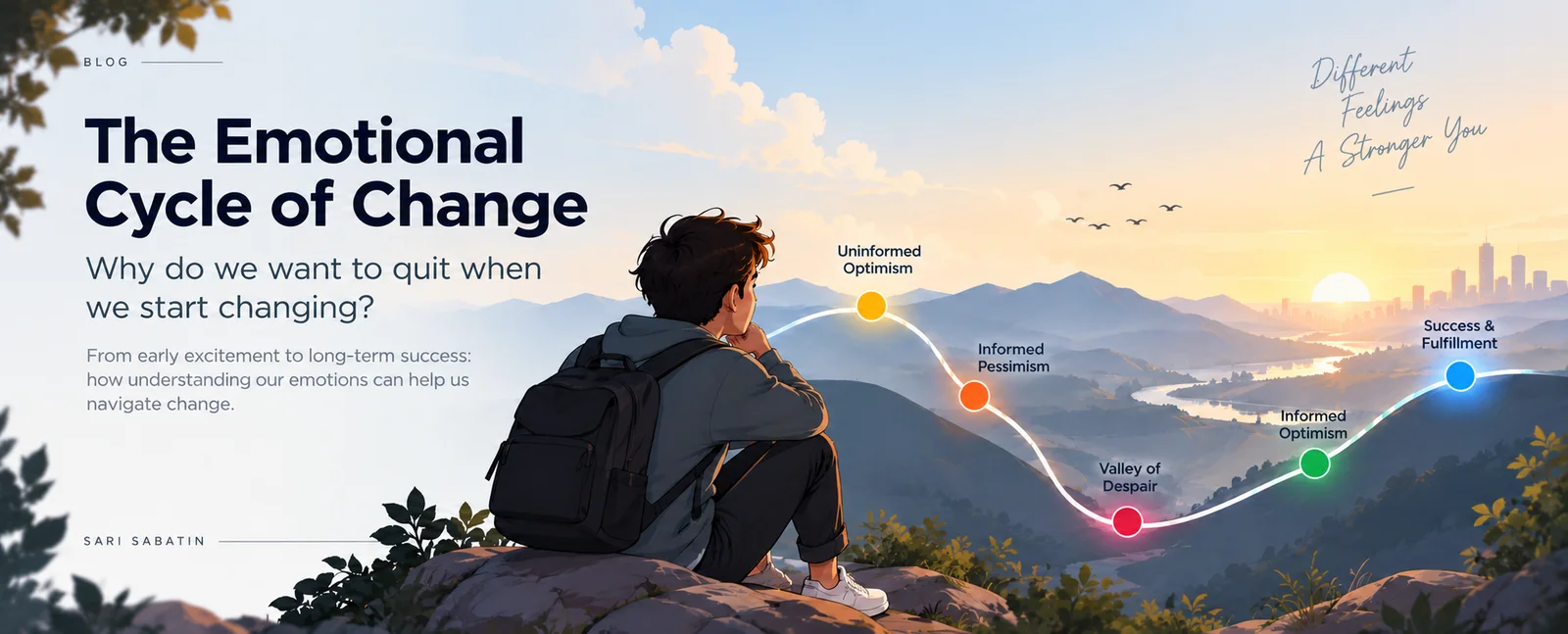
When we decide to change something in our lives, we often start with a high level of energy. A new job may look like the perfect opportunity. A new university may open many doors. A project may fill us with excitement. We may want to learn a new skill, or enter a relationship that we believe could take our lives in a better direction. At the beginning, we see the possibilities more clearly than the cost. Then reality starts to appear. The details become more difficult, progress takes longer than we expected, and the excitement that pushed us to begin starts to decline. At that point, we may ask ourselves: Did I make the right decision? Is the problem with the path, or with my decision to start in the first place?
This is where the idea of the Emotional Cycle of Change becomes useful. The model, developed by Don Kelley and Daryl Conner and described in their work published in The 1979 Annual Handbook for Group Facilitators, describes the emotional fluctuations that may accompany voluntary change. The core idea is simple: the emotions we experience during change do not always move in a straight line, and understanding when those emotions appear can help us make calmer decisions instead of interpreting every drop in motivation as a sign of failure.
What Is the Emotional Cycle of Change?
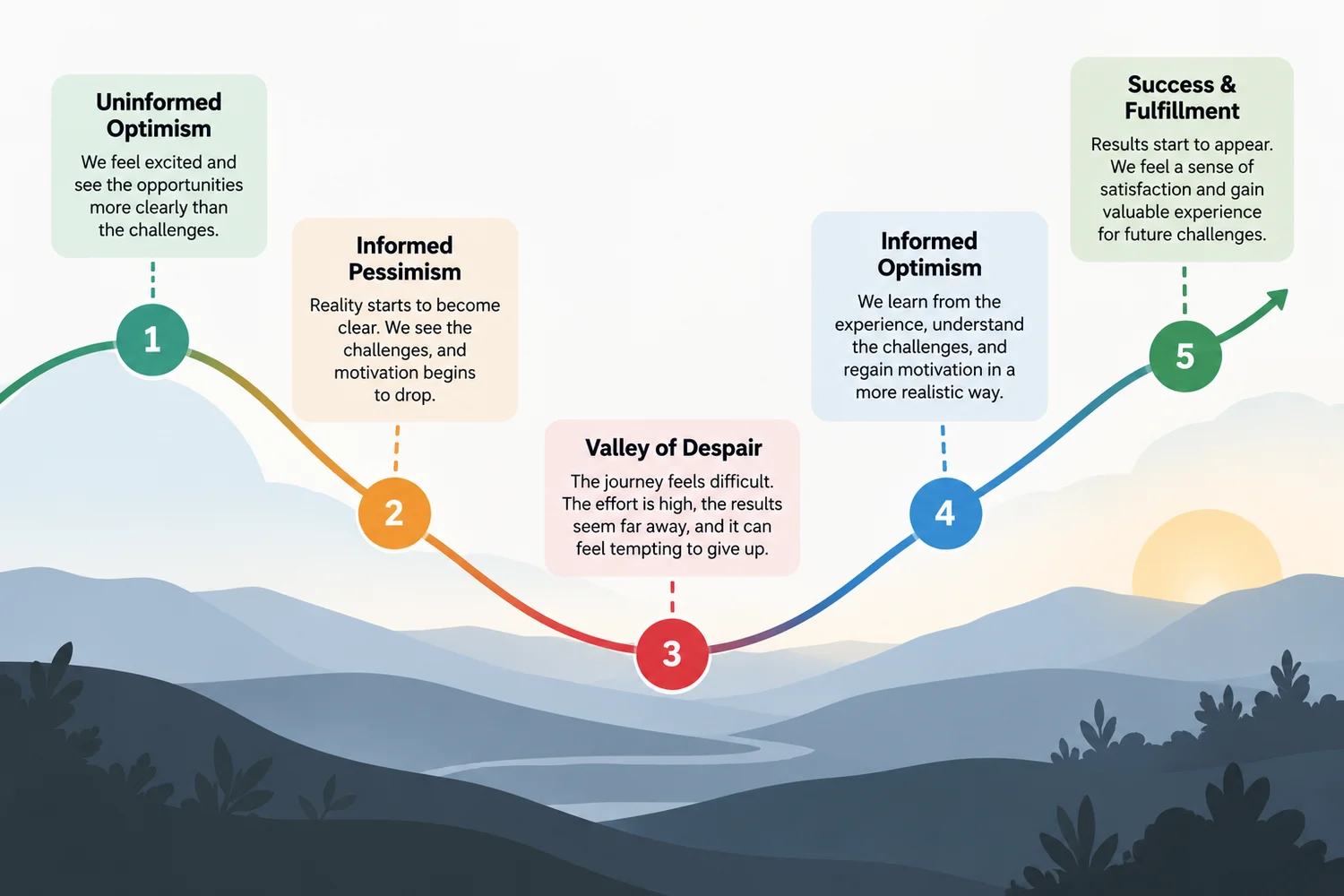
A visual representation of the Emotional Cycle of Change and its five stages.
The Emotional Cycle of Change can be viewed as a map that helps us read the emotional experience that comes with change. It does not suggest that everyone will go through the same stages in exactly the same order, and it does not give us a ready-made judgment about any decision. Its real value appears when we use it as a set of questions: Where am I right now? What has changed since I started? Is what I am feeling the result of a normal difficulty in learning and adapting, or is it actually telling me that there is a problem that needs to be reassessed?
The Five Stages of the Emotional Cycle of Change
1. Uninformed Optimism
We begin by seeing the possibilities more clearly than the challenges. Motivation is high because we have not yet experienced the amount of effort required. A new job may look like the perfect beginning, a new university may seem like a place full of opportunities, and learning a new skill may feel easier than it actually is. This stage is important because it gives us the energy to begin. At the same time, it can make our expectations higher than reality.
Practical example: You start a new job and believe that integrating into the team, understanding the systems and building relationships will happen quickly because the picture you saw before starting was simpler than the actual experience.
2. Informed Pessimism
This is where reality begins to change the picture. Challenges that were invisible at the beginning start to appear, and motivation begins to decline. We may feel tired, frustrated or uncertain. We may compare ourselves with others and start thinking about returning to what feels familiar. This stage does not necessarily mean that the change has failed. Sometimes it simply means that we have started to see it as it really is.
Practical example: A student who started university with a lot of enthusiasm may discover that academic requirements, exams and building new relationships require more effort than expected. The difficulty is real, but concluding that this place is not for me may be too early.
3. Valley of Despair
This is often the most difficult point in the journey. The effort has become obvious, while the results that motivated us to start may still feel far away. This is where the desire to stop can become strong, and we may start interpreting the entire experience through the emotions we are feeling at that moment. The danger is treating a temporary feeling as a final judgment on the decision.
Practical example: Someone starts practicing a new skill or changing a daily habit. After a period of trying, they see limited progress. At that moment, giving up may seem logical, even though the real issue may simply be that the skill needs more time before meaningful results become visible.
4. Informed Optimism
If we continue and learn from the experience, optimism begins to return in a different form. We are no longer optimistic because everything looks easy, but because we now have real experience of what lies ahead. We know where we need to improve, what worked and what needs to change. Our confidence becomes more realistic because it is built on experience rather than expectation.
Practical example: A new employee begins to understand the system, knows who to ask for help and handles situations that were confusing at first with greater confidence. The challenges have not disappeared, but their ability to deal with them has changed.
5. Success and Fulfillment
At this stage, the change becomes more stable in our lives or our work. We see the results, understand what we have learned and become more prepared for the next change. Success here does not mean reaching a perfect ending. It means reaching a point where something that once felt new or difficult has become clearer and more stable.
Practical example: After completing an academic program, reaching a good level in a skill or building a more mature relationship, we do not leave with the result alone. We also leave with a better understanding of ourselves and how we deal with challenges.
Why Does This Model Help Us Manage Our Emotions?
Perhaps the phrase managing emotions itself needs to be redefined. The goal is not to force ourselves to remain optimistic when we feel frustrated, and it is not to ignore anxiety simply because the model says that this can be a normal stage. Emotional awareness begins when we understand that a feeling is information, but it is not always a final judgment.
When we understand that a decline in motivation can be part of the change experience, we create more space to pause before making an impulsive decision. We can ask ourselves: Have the facts changed? Has a fundamental problem appeared? Do I still believe in the goal? Do I need to change the approach, or do I simply need more time and experience? These questions can turn our response to emotions from a quick reaction into a more conscious thinking process.
At the same time, we should not use the Emotional Cycle as an excuse to continue with everything. Sometimes walking away is the right decision. If new information fundamentally changes the picture, or the path no longer fits our goals, reassessment is part of maturity. The model helps us understand our emotions. It does not make the decision for us.
The Emotional Cycle of Change at Work
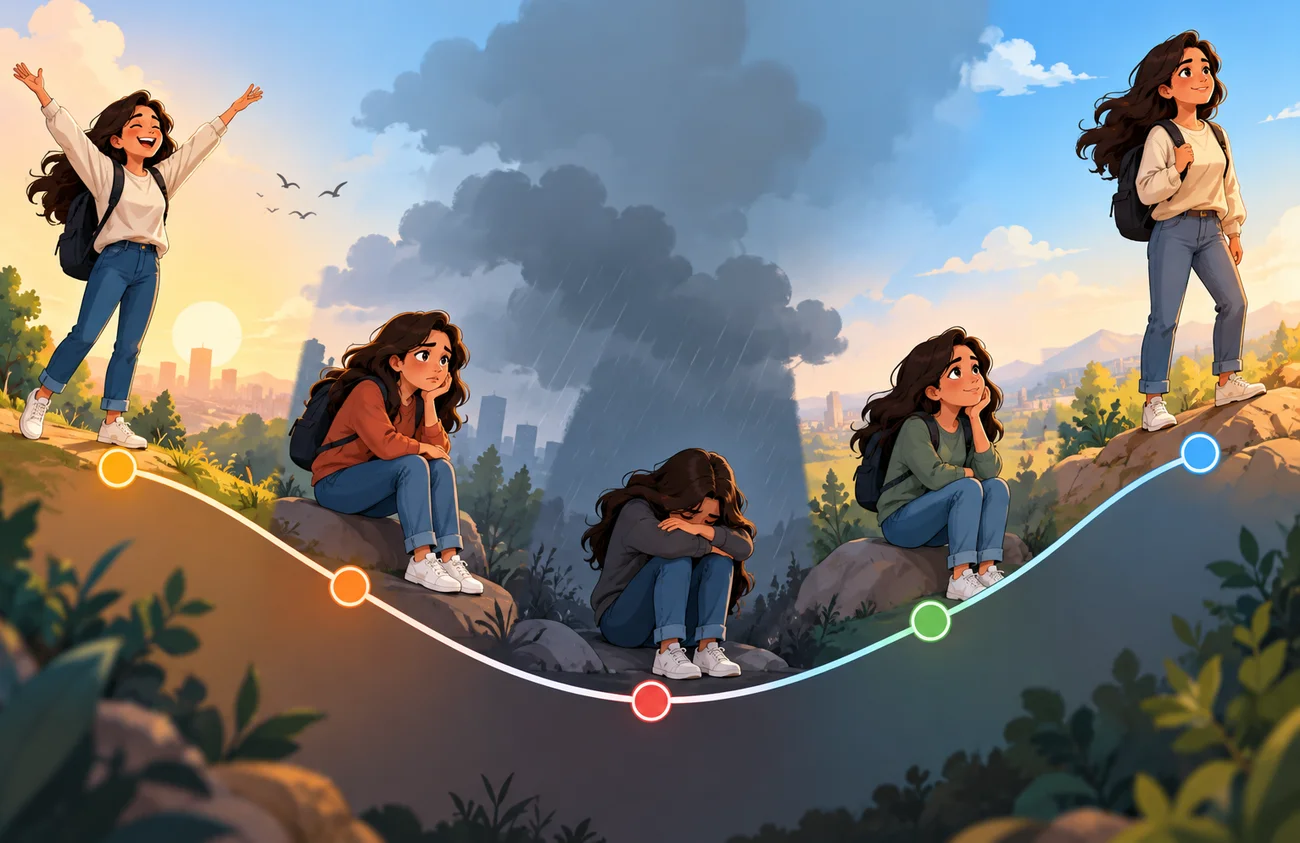
In the workplace, the cycle appears when a team starts a new project, moves to a different system, redistributes roles or adopts a new technology. At first, the conversation focuses on possibilities and opportunities. Once implementation begins, complications appear, and some people may start questioning whether the change is worth it. If a leader does not handle this stage consciously, they may interpret the decline in motivation as resistance or weak commitment, while the team may simply have moved from an optimistic picture to a more realistic understanding.
This is where leadership responsibility becomes important. A leader does not need to convince the team that everything is great. The leader needs to acknowledge that the path is difficult, explain what is happening, clarify what can be adjusted and identify what needs to continue. When people feel that the difficulty is understood and that there is space to learn, the transition from informed pessimism to informed optimism becomes more realistic. It is the same principle behind why most leadership programs fail: teams do not lose motivation because change is hard, they lose it when nobody names what is actually happening.
The Emotional Cycle in University and School

Moving to a new university or school is a clear example of how change is not only about the decision itself. It is also about what happens after the decision. At first, the focus is on opportunities, new friends and the new experience. Then come exams, time pressure, a different environment and new expectations. A student who does not understand this stage may interpret feeling overwhelmed as evidence that they chose the wrong place.
Understanding the cycle does not mean telling the student to just endure it. It is more useful to help them distinguish between the difficulty of adapting and a genuine problem that requires intervention. Sometimes they need better time management. Sometimes they need to build a support network or ask for academic help. Sometimes they genuinely need to reconsider their path. The difference starts with the ability to read emotions within their context.
The Emotional Cycle in Relationships

Relationships can also go through similar fluctuations. At the beginning, we see the positive qualities and possibilities. Over time, everyday differences begin to appear in communication, expectations and habits. A decline in excitement does not automatically mean that the relationship has failed, just as recurring problems should not be ignored simply because every relationship goes through difficult periods. What matters is understanding what we are learning from the experience, how we deal with disagreements, and whether the relationship is growing over time or becoming increasingly draining.
How Can We Use the Emotional Cycle of Change in Practice?
The best way to use the model is not to memorize its five stages. It is to use it as a tool for pausing and thinking. When your motivation drops during a change you have started, do not immediately ask: Should I stop? Ask first: What has changed since I started?
Then separate emotions from facts. You may feel that you are not making progress, but are there actual indicators showing that? You may feel that the decision was wrong, but has new information appeared that supports this conclusion?
Then ask another, perhaps more important, question: Is the problem with the goal, or with the approach? Sometimes we do not need to abandon the goal. We need to adjust the plan, slow down, ask for help or give ourselves more time to learn. That small distance between emotion and decision may be one of the most important forms of emotional intelligence. It is the same self-awareness I try to build with leaders through the Ofuq framework: understanding yourself well enough before deciding what to change next.
The Real Lesson: You Do Not Always Need to Feel Better. Sometimes You Need to Understand Better.
What I like most about the Emotional Cycle of Change is that it changes the question. Instead of asking, Why am I no longer motivated? We can ask, What is happening to me right now, and why? This simple shift makes emotions part of the learning process rather than an obstacle to it.
Change is not a straight path. We may start with excitement, then begin to doubt, and eventually reach a point where continuing feels unreasonable. Then we may discover that what we needed was not a new decision, but a deeper understanding of what we were experiencing. At the same time, we may discover that the change itself needs to be adjusted. In both cases, awareness gives us a better chance of making a better decision.
Perhaps the most important question when we feel like stepping back is not: How do I get rid of this feeling? It is: Do I really need to feel better right now, or do I need to understand what I am feeling before I decide?
Related reading: see also why most leadership programs fail, or explore the Ofuq leadership framework.
Frequently Asked Questions
Kelley, D. & Conner, D. R., The Emotional Cycle of Change, in The 1979 Annual Handbook for Group Facilitators.
The 12 Week Year, Facilitator's Guide and Participant Workbook, materials illustrating the five-stage Emotional Cycle of Change and the terminology Valley of Despair and Success & Fulfillment.
MindTools, Kelley and Conner's Emotional Cycle of Change, for an overview of the model and its original five-stage terminology.
Found this useful? Share it with your network.
 Share on LinkedIn