Executive Summary
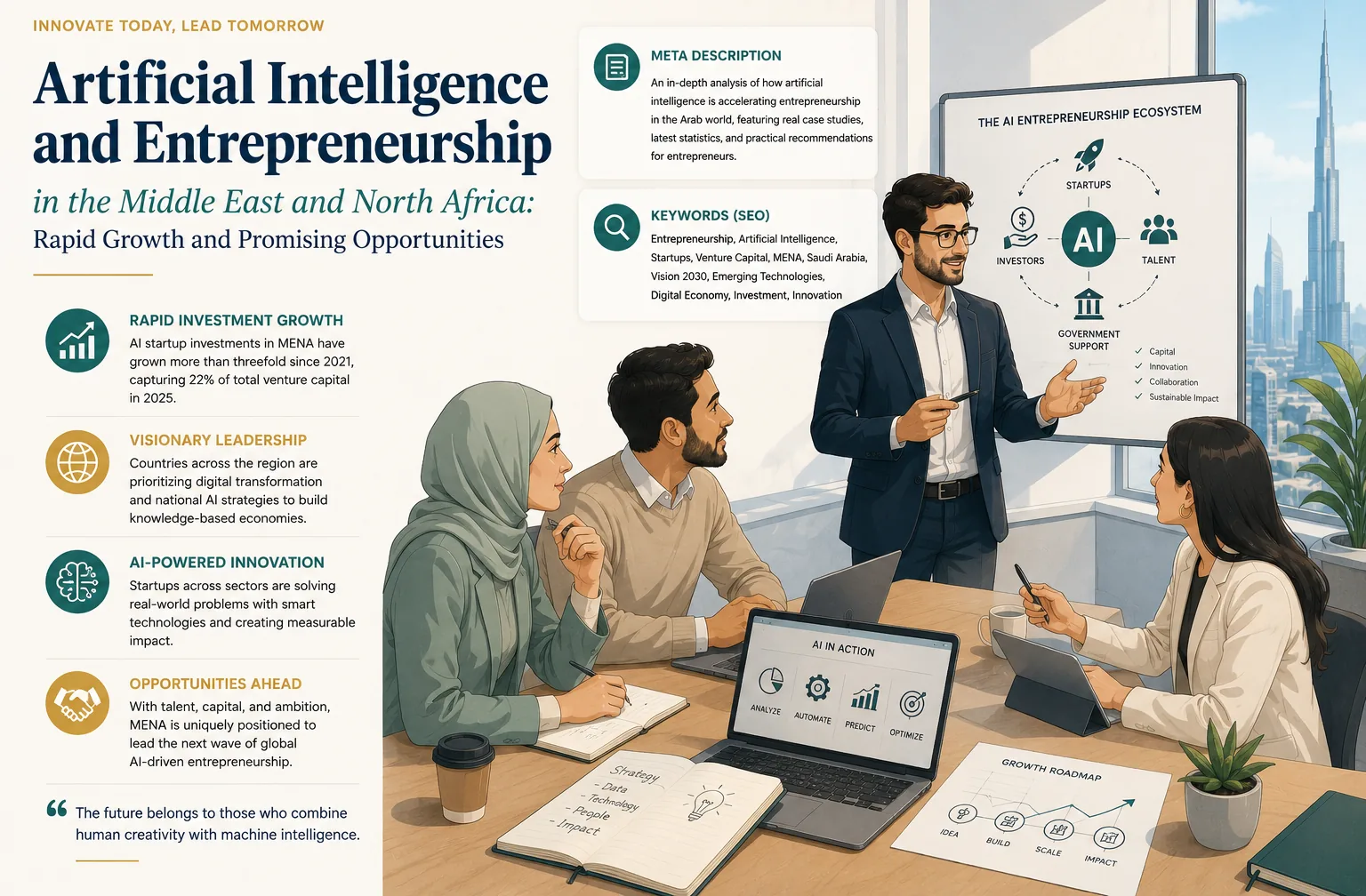
The Middle East and North Africa is experiencing an unprecedented acceleration in AI adoption across entrepreneurial ecosystems. AI-driven startups have attracted more than three times the investment levels seen in 2021 and accounted for approximately 22% of venture capital funding in 2025.
Governments in Saudi Arabia, the UAE, Qatar, and other Gulf countries are actively investing in AI infrastructure, digital transformation programs, and innovation ecosystems. Saudi Vision 2030 alone places Artificial Intelligence at the center of economic diversification and human capital development.
Globally, AI has evolved from a competitive advantage into a business necessity. Startups that effectively integrate AI into their operations are increasingly outperforming competitors in productivity, customer experience, and scalability.
The Regional AI Landscape
The MENA region is moving beyond AI adoption toward AI leadership. Startup funding directed toward AI ventures increased significantly between 2024 and 2025, with Saudi Arabia and the UAE emerging as regional innovation hubs.
According to recent McKinsey findings, 88% of organizations worldwide already use AI in at least one business function, while generative AI tools are increasingly being integrated into marketing, finance, operations, and customer support.
AI is enabling entrepreneurs to launch businesses with smaller teams, lower operational costs, and faster access to market intelligence than ever before.
Regional Success Stories
Leading Arabic customer experience analytics platform processing millions of interactions with 92% accuracy in Arabic sentiment analysis. Raised $30M in the region's largest AI funding round.
Introduced one of the region's first enterprise-grade Arabic Large Language Models, designed specifically for Arabic-speaking organizations across legal, healthcare, and technology sectors.
Transforming agriculture through AI-powered robotics, precision farming, crop monitoring, and predictive analytics that reduce waste and increase productivity across the region.
Key Statistics and Market Trends
AI startup funding in MENA increased by approximately 66% during 2024. AI startups receive around 28% more seed funding than non-AI startups. Around 63% of businesses report revenue growth after AI implementation, while 44% report measurable reductions in operating costs.
Economists estimate that AI could contribute more than $320 billion to Middle Eastern economies by 2030. The World Economic Forum expects AI to create millions of new jobs globally while simultaneously transforming existing roles.
Practical Recommendations for Entrepreneurs
- 1Start with a clear business problem rather than implementing AI for its own sake. Technology should serve strategy, not replace it.
- 2Invest in high-quality data and governance processes. AI is only as strong as the data it learns from.
- 3Build a Minimum Viable Product quickly and validate assumptions before scaling.
- 4Continuously monitor outcomes and retrain AI models as your business evolves.
- 5Address privacy, cybersecurity, ethics, and algorithmic bias from the beginning, not as an afterthought.
- 6Upskill your team in data literacy and AI fundamentals to ensure sustainable adoption across the organization.
Challenges and Risks
Entrepreneurs must address challenges including data privacy regulations, limited AI talent availability, infrastructure costs, and ethical considerations surrounding algorithmic bias and transparency.
Organizations that establish strong governance frameworks early are more likely to scale AI successfully and gain long-term trust from customers and investors.
Future Outlook
The convergence of Artificial Intelligence with IoT, robotics, cloud computing, and big data analytics will unlock new opportunities across healthcare, logistics, education, smart cities, and financial services.
The future of entrepreneurship will belong to founders who combine human creativity, emotional intelligence, leadership, and strategic thinking with the speed and analytical power of AI systems.
Related reading: See also What I Learned Managing a $2M Program with Four International Donors, or view selected program work.
Frequently Asked Questions
Found this useful? Share it with your network.
 Share on LinkedIn