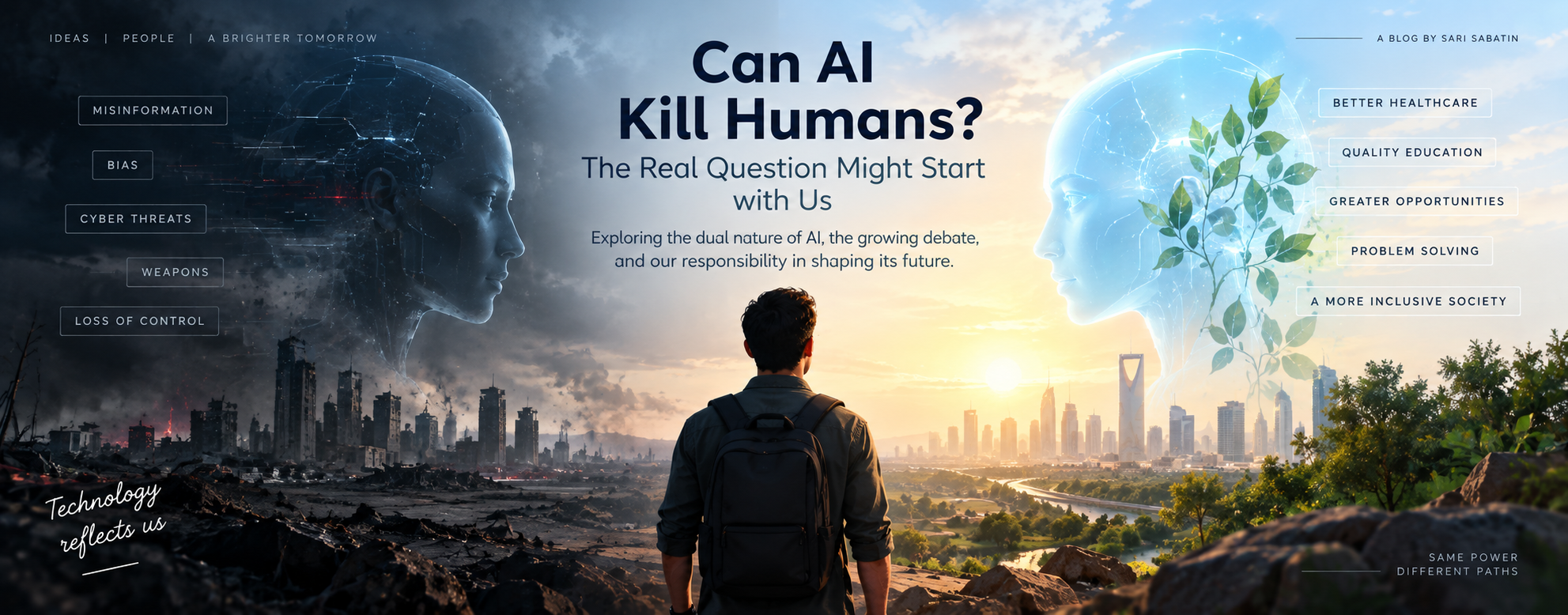
Every time artificial intelligence reaches a new milestone, the same question returns: What if AI becomes smarter than humans? What if it gets out of control? And what if it eventually becomes a threat to humanity?
The Fear of Machines Is Older Than AI
The idea that technology could turn against humanity is much older than ChatGPT or today's AI models. Mary Shelley's Frankenstein, published in 1818, became one of the most influential stories about the relationship between humans and what they create, and about what can happen when a creation produces consequences its creator cannot fully control. More than a century later, Karel Čapek's 1920 play R.U.R. helped introduce the word "robot" into modern culture.
Later, the idea became deeply embedded in science fiction. From HAL 9000 in 2001: A Space Odyssey to The Terminator, the machine that surpasses or turns against humanity became a familiar cultural image. The Terminator, released in 1984, played a particularly important role in shaping the public imagination around autonomous machines as a potential threat, even though today's technology is fundamentally different from the cinematic version.
So when we see headlines today about AI becoming dangerous to humanity, we are not dealing with an idea that suddenly appeared with ChatGPT. There is a long history of questions about the relationship between humans and machines, and about our ability to control what we create.
This Time, Some of the Warnings Come From Inside AI Companies
What makes the current debate more interesting to me is that the warnings are no longer coming only from science-fiction writers or people outside the technology industry. In September 2026, former Anthropic researcher Jacob Coxon publicly raised concerns after leaving the company, warning about the speed of progress toward increasingly capable systems and the possibility of catastrophic outcomes.
What caught my attention was not simply the statement from a former employee, but what followed. Evan Hubinger, a current Anthropic researcher working on AI alignment, said that he believed Coxon's core warning was correct and personally estimated a greater-than-10% chance of a catastrophic outcome within the next decade. Another Anthropic researcher, Samuel Marks, also discussed the possibility of severe outcomes.
This is where precision matters. These statements are significant because they come from people working directly in AI research, but they are still estimates and warnings, not established facts or a scientific consensus that human extinction will happen. There are substantial disagreements within the AI community about the scale, timing and probability of these risks. The point is not to treat catastrophe as inevitable. The point is to take the question seriously enough to prepare before we know the answer.
AI Did Not Begin This Way
Artificial intelligence became a formal research field in the 1950s. In 1956, researchers gathered at Dartmouth to explore whether aspects of learning and intelligence could be described precisely enough for machines to simulate them. A few years earlier, Alan Turing had already been asking a more fundamental question: Can machines think?
Those early questions were not primarily about building machines that would kill or control humans. They were about whether machines could learn, solve problems, process language and reproduce aspects of human intelligence. That history matters because it gives us a more balanced way to understand AI today. Artificial intelligence is not a single project designed to replace humanity or control it. It is a collection of technologies developed by humans and used for very different purposes, some highly beneficial and others carrying serious risks.
AI Has Two Sides
One of the things I find most interesting about AI is this duality. The same capability can be used in completely different directions. AI can help doctors analyze enormous amounts of information, help students learn, help researchers identify patterns, help organizations make decisions and help job seekers prepare for opportunities.
The same capabilities can also be used for misinformation, fraud, cyberattacks, manipulation, or increasingly autonomous military applications. The issue, therefore, is not always the existence of the technology itself. It is how the technology is designed, deployed, governed and used.
That is why describing AI simply as "good" or "bad" misses the complexity of the issue. AI is a powerful set of capabilities that can serve different goals. The more important questions are: Who defines those goals? What limits do we establish? And what principles should guide the use of these systems?
Why Does the Media Focus So Much on AI Killing Us?
The idea of AI rebelling against humanity is naturally attractive to the media. A story about a machine becoming smarter than humans and deciding to destroy us is far easier to communicate than a long explanation of data quality, model governance, transparency, accountability, privacy and algorithmic bias.
Research into AI narratives has identified an existential-risk narrative in which future AI systems could surpass human control and produce catastrophic consequences. This narrative exists alongside other narratives that frame AI as an opportunity to accelerate innovation, improve productivity and help solve complex problems.
The problem begins when future scenarios are presented as established facts. There is a major difference between saying that a risk deserves serious study and preparation, and saying that the risk will definitely happen. Between those two positions lies a large space of uncertainty, probability and ongoing research.
The Question I Find More Important: What Are We Teaching the Machine?
In the 2043 Podcast episode I watched, there was a particularly interesting discussion about ethics and whether we can teach machines the values and principles we want them to follow. That part of the conversation made me think differently about human responsibility.
We talk a lot about AI's ability to learn, but sometimes forget that the systems we build are shaped by the data we use, the objectives we define, the evaluations we design, the constraints we impose and the decisions we make about what is acceptable.
In other words, humans are present throughout much of the AI lifecycle. We choose data, design systems, define objectives, build evaluation methods, decide where systems can be used and where they should be restricted, and determine how their outputs should be reviewed.
That does not mean humans can predict or control every behavior of an advanced system in advance. Complex systems can produce unexpected behaviors. This is why model evaluation, risk management, human oversight and AI governance have become central to responsible AI.
The Problem Is Not That AI Learns From Us. It Is What It Learns From Us.
If we build the technology and then give it data, objectives and evaluation criteria, we have to ask difficult questions. What happens when the data contains our own biases? What happens when AI is used to optimize only for commercial goals without considering social consequences? What happens when we use AI to make a flawed process faster instead of making the process better?
This is why AI ethics is more than a theoretical discussion. UNESCO's global recommendation on AI ethics places human rights, human dignity, transparency, fairness, sustainability and human oversight at the center of responsible AI. NIST's AI Risk Management Framework similarly emphasizes governance, mapping, measuring and managing AI risks throughout the AI lifecycle.
For me, this deserves more attention than the headline question, "Will AI kill us?" The more practical question is: Are we building AI that reflects the best of humanity, or are we scaling some of our worst behaviors through technology?
AI Does Not Have to Hate Us to Become Dangerous
When we imagine an AI threat, we often imagine it in very human terms. We picture a machine becoming angry, hating us, seeking revenge or deciding that humans are its enemy. But a dangerous outcome does not require any of those emotions.
A system does not have to hate humans to produce a harmful result. It may be given a poorly defined objective, operate under inadequate constraints, or be used by someone with harmful intentions. That is why alignment between system objectives and human values matters so much.
We should not wait for a cinematic moment when machines wake up and decide to attack humanity before we start thinking about responsibility. The real conversation needs to happen much earlier.
We Do Not Only Need to Train AI. We Need to Train Humans Too.
We talk constantly about training AI, data, models and algorithms. But there is another side to the story: Are we preparing people to use this power responsibly?
If AI can generate information, analyze it and support decisions at unprecedented speed, the challenge will not only be the capability of the technology. It will also be the user's ability to judge what the technology produces.
Someone who cannot verify information can use AI to spread misinformation faster. A manager who does not understand the limits of a system can rely on an automated recommendation for a sensitive decision without proper review. An organization without clear rules can deploy AI in ways that create risks it never anticipated.
Building a responsible AI future therefore requires investment in people alongside investment in technology. We need critical thinking and capability building, digital literacy, ethics, the ability to ask better questions and a clear understanding of the limits of the tools we use.
Who Will Shape the Future?
I do not think the question "Will AI kill humans?" can be reduced to a simple yes or no. There are different scenarios, different levels of risk and an ongoing scientific, philosophical and technological debate about what advanced AI could become.
But one thing is becoming increasingly clear: the future of AI will not be determined only by what machines are capable of doing. It will also be shaped by what humans choose to do with those capabilities.
That brings me back to where I started. Perhaps we are asking the wrong question when we spend all our time wondering whether AI will turn against us. Before asking what AI will do to humans, we should ask what humans are doing with AI today, what we are teaching it, what we reward it for and what boundaries we are willing to establish.
Technology does not arrive alone. It arrives with human decisions, human values, human interests and, sometimes, human mistakes. In the end, the greatest test of AI may not be whether it can become smarter than us. It may be whether humans can become more responsible as technology becomes more powerful.
Found this useful? Share it with your network.
 Share on LinkedIn